Arts & Culture
·
Story
Dunedin - New Zealand
Edith Collier, a Modernist Ahead of Her Time
Edith Collier returned to New Zealand with an artistic language shaped by European modernism. It would take her country decades to understand just how far ahead she had travelled.
Santiago Bonhomme

Edith Collier, Boy Against Landscape, 1914–15, oil on canvas. Collection of the Edith Collier Trust, in the permanent care of Te Whare o Rehua Sarjeant Gallery.
ON VIEW | Edith Collier: Early New Zealand Modernist | Dunedin Public Art Gallery, 30 The Octagon, Dunedin | 3 October 2026–8 February 2027 | Open daily, 10am–5pm
Edith Collier, a Modernist Ahead of Her Time
Sometimes a country takes decades to recognise what was there all along. Edith Collier belongs to that kind of story.
Born in Whanganui in 1885, Collier became one of the earliest New Zealand artists to engage seriously with European modernism. Her life, though, is also a story about distance, misunderstanding and the difficulty of returning home with new ideas to a country that was not always ready to receive them.
On 3 October, Dunedin Public Art Gallery opened Edith Collier: Early New Zealand Modernist, the first major survey of her work since 1999. The exhibition arrives at a moment of renewed interest in her work, both in New Zealand and overseas, and offers a chance to reconsider an artist whose place in this country’s art history took far too long to be properly recognised.
Collier travelled to England in 1913, aged 28, and stayed in Europe for almost nine years. London, Ireland and Cornwall all shaped an artistic education that gradually took her beyond the conventions she had grown up with in New Zealand.
She studied with Australian artist Margaret Preston and also worked alongside Frances Hodgkins, one of the central figures in New Zealand art. Hodgkins was among those who recognised Collier’s talent early. During those years, Collier began simplifying forms, intensifying colour and experimenting with a visual language close to post-impressionism. Some of the work she produced in London during the First World War placed her, for a New Zealand artist of that period, remarkably close to the European avant-garde.

Edith Collier, Buildings, Leinster Square, c.1918, oil on canvas. Collection of the Edith Collier Trust, in the permanent care of Te Whare o Rehua Sarjeant Gallery.
In her portraits and landscapes from those years, figures become less rigid, colours more intense, and forms less bound by literal representation. There is something deliberately modern in the way she looks at the world. Collier seems increasingly less interested in simply reproducing what is in front of her and more interested in finding another way of seeing it.
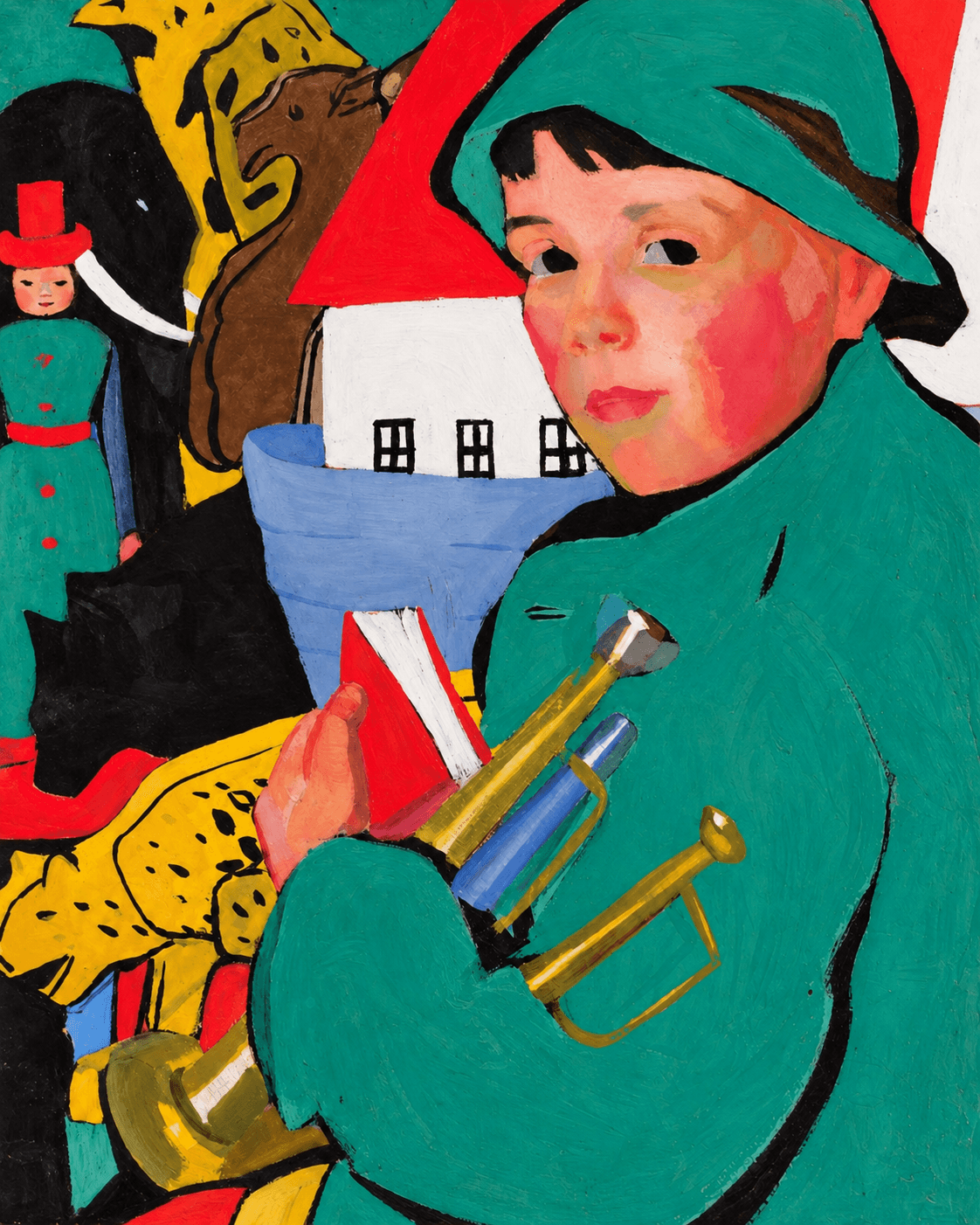
Edith Collier, Boy with Noah’s Ark, c.1916–17, gouache on card.
Her return to Whanganui in 1922 changed the course of that trajectory.
She came back to a considerably more conservative society, and to a family life that would increasingly demand her attention. She continued to paint and exhibit, but the reception of her work was far from straightforward. In 1926, a local critic accused her of “distorting” nature under the influence of what he regarded as an artistic fashion. That same year, her father, disappointed by some of her work, destroyed several of her paintings.
The story sounds almost unbelievable today, but it points to something larger. Collier did not return home lacking talent or training. She returned with a sensibility that had moved faster than the cultural world she came back to.
That did not mean she stopped working. She continued to paint landscapes and portraits, and produced important work during a stay in Kāwhia in the late 1920s. She also exhibited in Wellington and Christchurch. But the intense period of experimentation she had experienced in Europe never quite regained the same momentum. Over time, family responsibilities increased and she gradually moved away from painting. Collier died in Whanganui in 1964.
Recognition came later.
Looking again at Edith Collier today also means asking how a country builds its cultural history, and who gets left outside that story for too long. Her work has re-entered international conversations amid a broader reassessment of women who took part in European modernism, and the exhibition now showing in Dunedin is part of that wider recovery.
Edith Collier: Early New Zealand Modernist will remain at Dunedin Public Art Gallery until 8 February 2027. It is not simply a chance to discover a remarkable painter. It is also an invitation to ask how long a work of art sometimes has to wait before its own country finally learns how to see it.
Keep the conversation going
This story doesn’t end here.
Read something that stayed with you? Join the discussion, meet the writer behind the story, or help make the next one possible.
Join the discussion on Facebook

Santiago Bonhomme
Santiago Bonhomme is a writer and journalist based in Queenstown, New Zealand. His work explores culture & arts, society, identity and the ways people and places shape one another.
Buy the team a coffee
Tag Zealanding on Instagram
Keep Zealanding
Arts & Culture
Their Arms Shall Rest Now
Central Otago writer Jillian Sullivan reflects on loss, memory and the quiet responsibility of carrying on.

Arts & Culture
The Country That Found the Shire
An imagined geography found a real one. On Hobbit Day, Zealanding reflects on how Middle-earth became attached to the landscapes of New Zealand.
A NOTE FROM THE EDITORS
Send Zealanding a local story lead, contact, photograph, idea or tip. The best stories often begin with a quiet nudge.