Arts & Culture
·
News / Report
Clyde / Central Otago
When Lawyers Make Room for Stories
A trip to Clyde to collect a writing prize for Zealanding co-founder Santiago Bonhomme became a larger story about lawyers, words and what can happen when a local business decides to invest in the cultural life of its community.
Cesar Carvajal
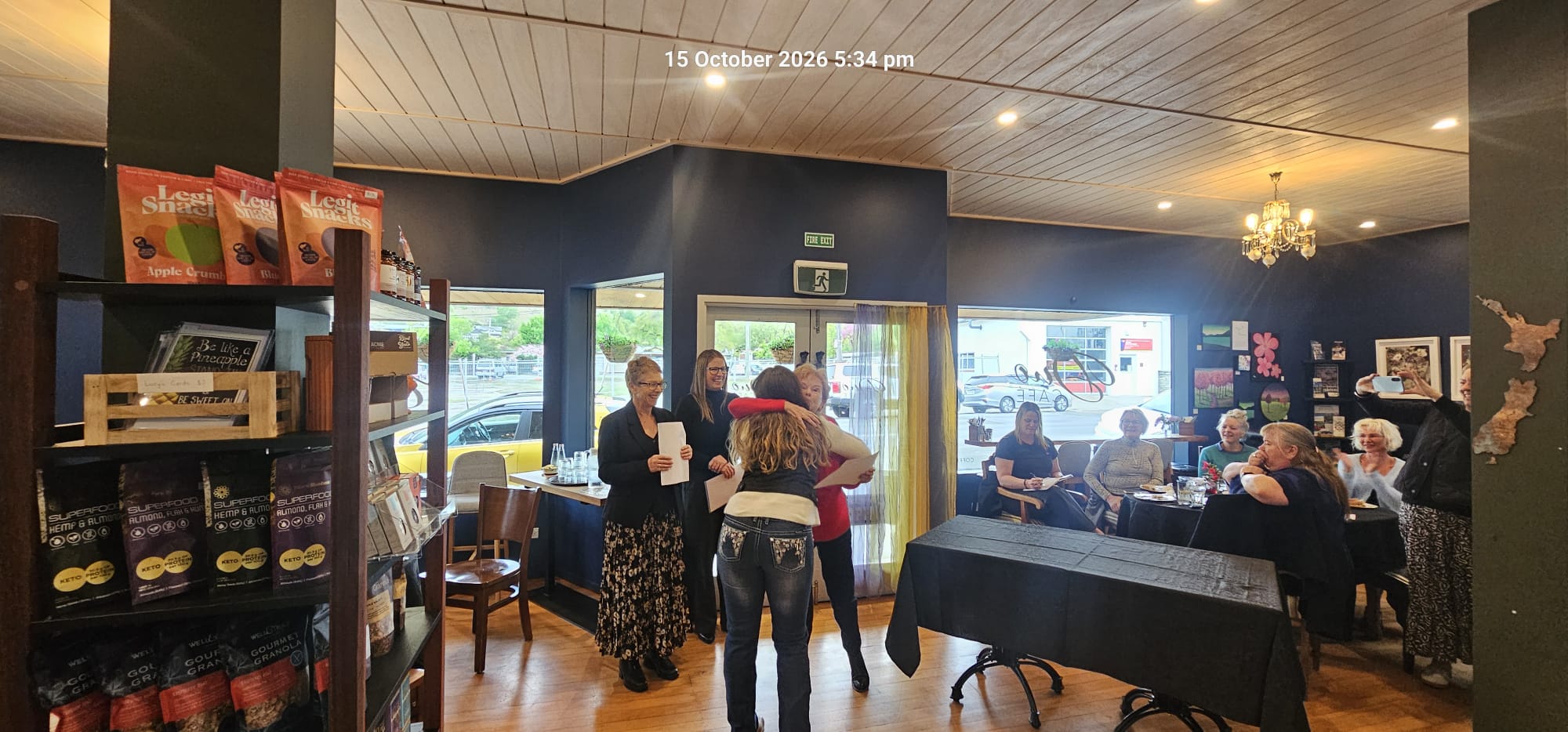
Writers, judges, guests and members of the Central Otago community gathered at Duo Cafe in Clyde for the inaugural Checketts McKay Short Story Competition awards.
Last Thursday I went to Clyde to receive an award that wasn't mine. Santiago Bonhomme had won first place in the Open category of the inaugural Checketts McKay Short Story Competition, and because he couldn't be there, I went to the ceremony on his behalf. I was proud of him, of course, and also quietly amused by the unusual situation of sitting in a café waiting for somebody to call another person's name so that I could stand up for him. But as the afternoon unfolded, I became interested in something beyond the result itself. Around us were writers, judges, lawyers, families and people from the community, gathered in a café in Clyde because a law firm had decided that writing was something worth investing in. By the time the winners were announced, I was thinking as much about Checketts McKay as I was about the competition.
Perhaps I noticed it because I understood part of the connection immediately. Before writing became such an important part of my life, I was a lawyer, and one of the things people sometimes underestimate about law is just how much of it happens through language. Lawyers spend enormous amounts of time reading and writing. We construct arguments, interpret words, negotiate what sentences mean, choose whether a comma changes an obligation and occasionally produce several pages explaining why somebody else's several pages do not mean what they say they mean. The subjects may be contracts, court documents, property transactions or legal opinions rather than fiction, but words are among the fundamental tools of the profession.
That was why something Gillian Clarke said before the winners were announced stayed with me. Speaking about the origins of the competition, she returned to the relationship between lawyers and words. It wasn't presented as though a group of lawyers had suddenly discovered literature. The connection was more natural than that. Words are already part of their working lives, and when the firm started thinking about how it could support the arts locally, a writing competition made sense. Clarke had expressed a similar idea when the initiative was launched earlier this year, explaining that the firm wanted to find something that aligned with who they were and what they did, and that words were part of that.
I felt identified with that immediately.

The inaugural Checketts McKay Short Story Competition brought writers and readers together in Clyde in October 2026.
A competition about a place
Checketts McKay describes itself as a Central Otago law firm, with offices in Cromwell, Alexandra, Wānaka and Ranfurly. Its lawyers work in the same communities the competition asks people to write about.
That local connection is important because the competition was not designed simply as a generic national writing prize with a company's logo attached to it. Every Open-category story had to contain some connection with Central Otago or Queenstown Lakes, although writers were deliberately given considerable freedom over what that connection could mean. It could appear through landscape, history, memory, community, characters or imagination. The Open category was available nationally to adult New Zealand citizens and permanent residents, while separate categories invited children and teenagers from schools across Central Otago and Queenstown Lakes to participate.
That distinction matters to me. There is a difference between sponsoring culture and helping create the conditions in which culture can happen. A logo at the bottom of an arts event can certainly be useful because somebody has to pay for things, but this initiative goes further. The firm created the competition, funded the prizes, brought together judges, worked with schools and built a digital collection where stories can be read afterwards. In the Open category alone, first place carries $2,500, followed by $1,000 and $500 for second and third, while the schools competition reaches students from Years 5 and 6 through to Years 9 to 13. Checketts McKay says its intention is for the competition to become annual.
Perhaps the most important part of that work begins much earlier than the prizegiving. The published school results show stories coming from Dunstan High School, Arrowtown School, Omakau Primary, Cromwell College, Mount Aspiring College, St Gerard's Primary and other schools across the region. Some wrote about gold, some about rivers, mountains and familiar landmarks, while others took the landscape into stranger and more imaginative places. The judges' report encouraged students to think not only about description but about character, dialogue, originality and the arc of a story, reminding them that writing is a skill that continues growing whether or not a prize arrives at the end.
I like that enormously, because cultural life is not created only by the people who are already writers. It also depends on somebody telling a twelve-year-old that the story they wrote is worth reading.
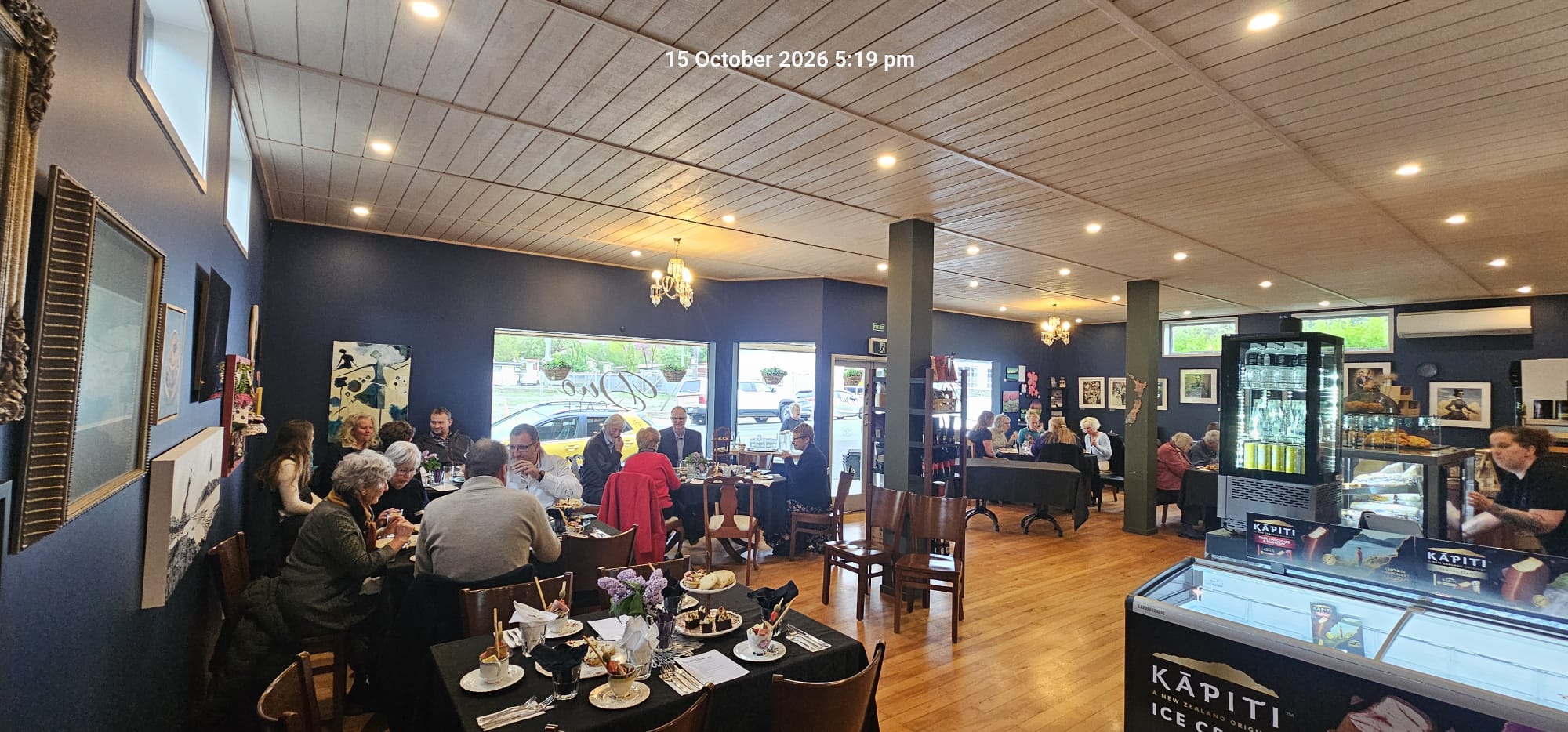
The awards afternoon at Duo Cafe in Clyde brought together writers, judges, organisers and members of the community. Photo: Cesar Carvajal / Zealanding
Lawyers, writers and judges
The judging panel also reflected that interesting bridge between professions. Rosemary Riddell spent decades first as a lawyer and then as a District Court judge before writing To Be Fair: Confessions of a District Court Judge, directing film and becoming involved with writers' residencies. Bridget Auchmuty, who lives in the Ida Valley, has taught fiction and poetry in creative-writing programmes and published her own work in New Zealand and overseas. Annie Villiers, who has deep connections with Central Otago and has published poetry and fiction, assisted as Chief Sifter.
There was something satisfying about sitting in that room knowing that the boundaries between these worlds were not as rigid as we sometimes imagine. A judge can also be a writer. A lawyer can care deeply about fiction. Someone who spends their professional day dealing with property, estates or commercial agreements can still understand that a community needs poetry, stories and imagination as much as it needs competent legal work. We tend to organise people according to their professions because it makes the world easier to classify, but human beings are rarely that tidy.
Even the afternoon tea had been pulled into the literary theme. On the tables was a menu inspired by Katherine Mansfield's short stories: Prelude became a selection of New Zealand cheeses and antipasto, Bliss a chocolate brownie, Bank Holiday a Kiwi sausage roll, Her First Ball a miniature date scone, while The Garden Party, At the Bay, The Fly and A Cup of Tea appeared in various edible forms before the afternoon was over. It was a small detail, perhaps, but a lovely one. Somebody had thought about the event as more than an announcement of first, second and third place. Literature had been allowed to enter the room.
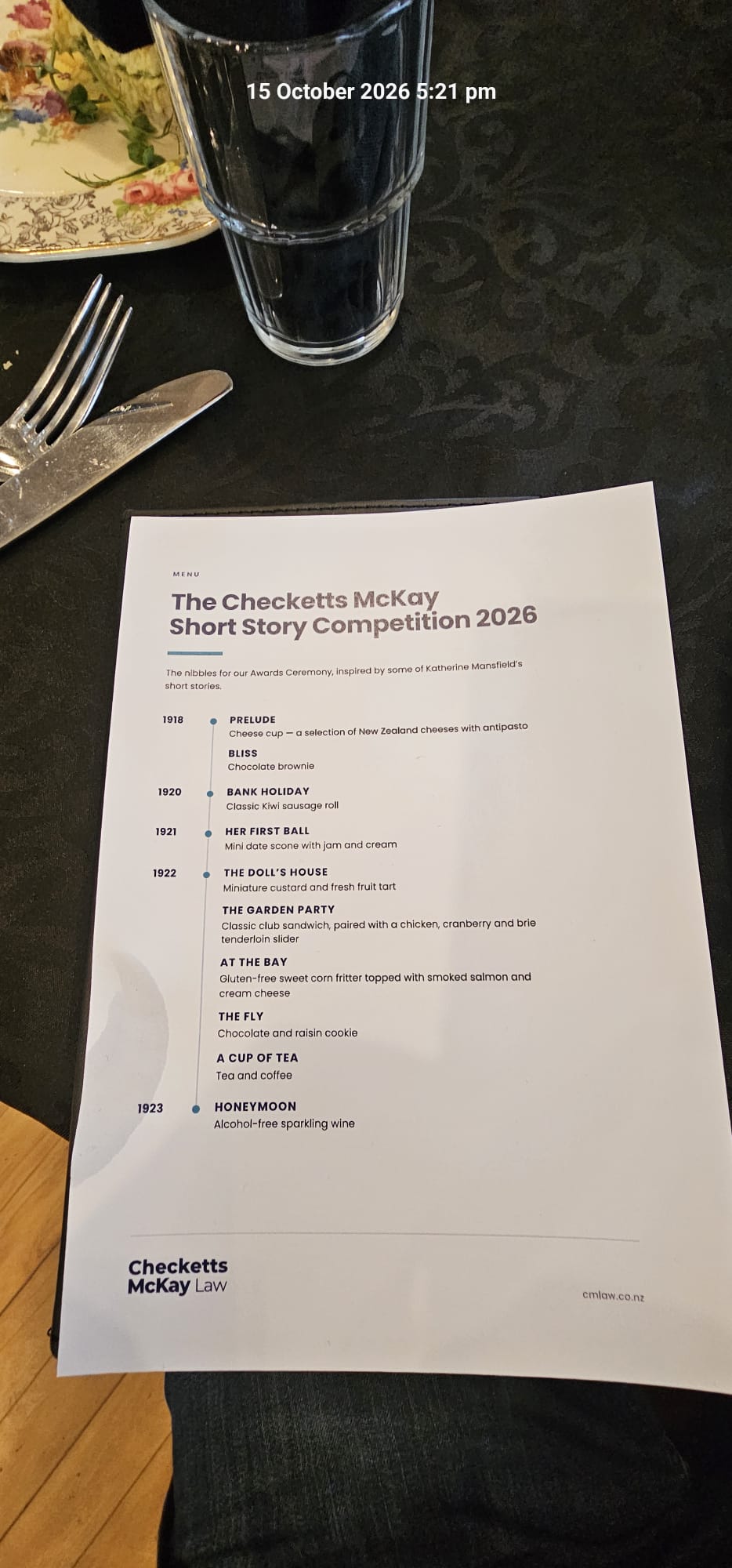
The awards menu took inspiration from Katherine Mansfield's short stories, bringing literature all the way onto the table. Photo: Cesar Carvajal / Zealanding
And then there was Santiago
For Zealanding, the afternoon had another meaning. Santiago Bonhomme is my co-founder at Zealanding, and much of what we are building together comes from a shared belief that writing can be a way of understanding the country where we live. We arrived in New Zealand from different parts of South America, Santiago from Chile and me from Colombia, and over time writing has become one of the ways we participate in this place: observing it, asking questions about it and trying to contribute to its cultural conversation. So seeing Santiago win first place in a competition centred on stories connected with Central Otago and Queenstown Lakes felt particularly meaningful. It was not simply that one of our writers had received an award. One of the two people building Zealanding had been recognised for the very thing that sits at the heart of the project: telling stories about New Zealand.

Santiago Bonhomme, Zealanding co-founder and first-place winner in the Open category of the inaugural Checketts McKay Short Story Competition.
I don't want to make his achievement larger than the article itself, because this story belongs primarily to the cultural space Checketts McKay has created and to everyone who participated in it. But I do want to stop for a moment and say that I am proud of him. Santiago and I spend a lot of time talking about stories, editing, ideas and what Zealanding might become, but writing itself is still a very solitary act. Someone sits with an idea, writes a sentence, dislikes it, rewrites it, moves a paragraph, deletes half of it, reads it again the following morning and wonders whether any of it makes sense. Eventually the work leaves the computer and enters a world in which somebody else gets to decide whether it connects.
On this occasion, the judges decided Santiago's story did.
I went to Clyde because he couldn't be there, and standing in his place for those few moments made me think about the strange way projects like Zealanding slowly become real. It begins with conversations between two people, drafts moving back and forth, ideas that may or may not become stories, and the belief that there should be another space in New Zealand for people to read, write and think together. Then one day one of those people wins a short story competition in Central Otago, the other one is sitting in a café in Clyde collecting the certificate, and somehow the project is participating in the cultural life it was created to be part of.
That is exactly the kind of room I want Zealanding to be present in, not because we need to place ourselves at the centre of it, but because these are the places where literary culture actually exists: between writers, readers, judges, schools, businesses, cafés and people willing to give an idea their attention.

The certificate I brought home for Santiago Bonhomme after he received first place in the Open category. Photo: Cesar Carvajal / Zealanding
What does a business give back?
I have been thinking quite a lot recently about what responsibility businesses have towards the places where they operate. Usually that conversation moves quickly towards environmental impacts, employment, taxes, sponsorships or charitable giving, all of which matter. But there is another form of contribution that is harder to measure: helping a place develop a cultural life.
Central Otago is easy to describe through landscape. Mountains, vineyards, rivers, orchards, dry hills, old gold towns and enormous skies provide an almost unfair amount of material. Queenstown Lakes has the same problem in a different form: photographs arrive before sentences. But a place becomes more than scenery when people begin writing about what happens there, remembering its past, inventing characters within it, arguing about its future and allowing the landscape to acquire stories that did not exist before.
That work requires writers, certainly, but writers also need ecosystems. They need readers, editors, libraries, publishers, competitions, festivals, schools, cafés, bookshops and organisations prepared to say that creative work has value. None of those institutions needs to do everything. Sometimes contributing to culture can simply mean recognising where your own skills and resources intersect with something the community could use.
That seems to be what Checketts McKay has done here.
The firm could have chosen many ways to promote itself. Instead, somebody noticed a connection that was already present in their profession: lawyers work with words. From that observation came a competition that has encouraged adults across New Zealand to write about Central Otago and Queenstown Lakes, encouraged local children to invent stories about the places around them, paid writers for their work and created another small gathering point for the region's literary life. The firm has said it hopes to repeat the competition annually, which may ultimately be the most important part of the whole idea. One competition creates winners. A competition that returns year after year can become part of a culture.
Competitions like this depend on more than writers alone: readers, judges, organisers, schools and local institutions all help create a literary culture. Photo: Cesar Carvajal / Zealanding
Keeping the stories alive
When the afternoon finished, I left Clyde carrying Santiago's certificate. It said first place, which was the reason I had gone there in the first place, and I was very happy to take it back to him. But the certificate was not really what I kept thinking about on the way home. I kept thinking about Gillian's comment about lawyers and words.
I spent years working with words as a lawyer before I began using them differently as a writer. In one life, words were tools for precision, argument and legal consequences. In the other, they became tools for memory, curiosity, imagination and trying to understand where I live. I don't see those lives as completely separate anymore.
Perhaps Checketts McKay doesn't either.
And there is something encouraging about that. Culture doesn't only happen inside institutions labelled culture. Sometimes it happens because a law firm decides to run a short story competition, a judge spends her retirement writing, a teacher encourages a student to enter, a café fills with people listening to the names of writers, or someone who could not attend sends a friend to collect a certificate in Clyde.
Zealanding is very happy to have been in that room.
Because places need roads, businesses, lawyers and houses, but they also need people willing to tell their stories.
And sometimes all a story needs is someone willing to make room for it.
Sources & Further Reading
Primary reporting
Cesar Carvajal attended the Checketts McKay Short Story Competition awards at Duo Cafe, Clyde, on 15 October 2026. Event observations, Gillian Clarke's remarks and Santiago Bonhomme's first-place award are based on first-hand reporting.
Checketts McKay Law - Short Story Competition 2026
Competition purpose, eligibility, prizes, judges, regional theme and intention to hold the competition annually. Checketts McKay Short Story Competition 2026
Checketts McKay - 2026 story collection
Published school winners, selected stories, judges' report and background on the competition. Stories from where we live and work
Otago Daily Times - Short story competition open for old and young alike
Gillian Clarke on why a writing competition resonated with a law firm and its desire to support the arts. Read the ODT report
Checketts McKay Law - Contact
Firm locations across Cromwell, Alexandra, Wānaka and Ranfurly. Checketts McKay locations
Keep the conversation going
This story doesn’t end here.
Read something that stayed with you? Join the discussion, meet the writer behind the story, or help make the next one possible.
Join the discussion on Facebook

Cesar Carvajal
Cesar Carvajal is writer and editor in New Zealand. His work explores migration, culture, place, identity and the ways people participate in the communities they call home.
Buy the team a coffee
Tag Zealanding on Instagram
Keep Zealanding

Arts & Culture
From Wellington to the World: Pip Adam and the Journey of Audition
Pip Adam’s Audition began in Wellington, crossed the Pacific and has now won the 2026 Ursula K. Le Guin Prize for Fiction.

Arts & Culture
Looking at Picasso Again
Picasso may be one of the most familiar names in modern art. A new Auckland exhibition asks whether, behind the fame, there is still something left that can surprise us.

Arts & Culture
Anne Carson, the Poet Who Refused to Stay Inside Poetry
The 2026 Nobel Prize recognises a writer who has spent decades making ancient literature feel intimate, unstable and completely contemporary.
A NOTE FROM THE EDITORS
Send Zealanding a local story lead, contact, photograph, idea or tip. The best stories often begin with a quiet nudge.