Arts & Culture
·
Story
International
Anne Carson, the Poet Who Refused to Stay Inside Poetry
The 2026 Nobel Prize recognises a writer who has spent decades making ancient literature feel intimate, unstable and completely contemporary.
Santiago Bonhomme

Anne Carson at the 2024 National Book Awards finalist reading in New York. Photo: Jay Dixit / Wikimedia Commons, CC BY-SA 4.0.
There are writers who build a body of work and others who alter our idea of what literature is allowed to do. Anne Carson belongs to the second group. On 8 October, the Canadian poet, essayist, translator and classicist was named the 2026 Nobel Prize in Literature laureate. The award recognises a career that has moved constantly between ancient Greece and contemporary life, between scholarship and desire, between thought and emotion.
To read Carson is to enter a literature where categories quickly become unreliable. In Autobiography of Red, she begins with the ancient poet Stesichorus and turns the monster Geryon into a vulnerable boy with red wings who takes photographs, falls in love and discovers the pain of being left behind. In The Beauty of the Husband, the end of a marriage unfolds through twenty nine tangos. In Nox, written after the death of her brother, photographs, dictionary entries, fragments and memories become part of the mourning. The form is never decoration. It is part of what the book is trying to understand.
That is one reason Carson matters. She does not simply borrow from the classical world. She makes it unstable again. Sappho, Euripides and ancient Greek vocabulary become instruments for examining jealousy, sex, betrayal, grief and memory. In her translation of Sappho, If Not, Winter, even the gaps in the surviving poems remain visible on the page. Absence itself becomes something the reader must encounter.
Born in Toronto in 1950, Carson trained as a classicist and taught ancient Greek literature for many years. Her scholarship is essential to her writing, but the work never feels trapped inside the academy. She can follow the history of a word, move into autobiography and return to an ancient text without asking permission from genre.

Anne Carson at the 2024 National Book Awards finalist reading. Photo: Jay Dixit / Wikimedia Commons, CC BY-SA 4.0.
This freedom was already visible in Eros the Bittersweet, her early study of desire, where literary criticism comes close to poetry. It reaches another intensity in The Glass Essay, a long poem in which the Brontes, the Canadian landscape, a mother and the aftermath of a failed relationship occupy the same emotional space. Carson does not explain the connections in advance. She lets them gather meaning.
For all the complexity of her work, she is not obscure for the sake of being obscure. Her best pages are often remarkably clear. A Carson sentence can be dry, funny, severe and suddenly devastating. She trusts images and gaps. She knows when not to explain. The intelligence of the work lies not in displaying knowledge but in discovering what knowledge cannot solve.
Carson returns repeatedly to experiences that resist explanation. Why do we desire what escapes us. What remains of another person after death. What happens to love when beauty, trust or language fail. Her classical learning gives these questions depth, but never closes them.
Perhaps this is why Carson feels so contemporary. Our lives arrive in fragments, through messages, images, quotations, memories and interrupted attention. Carson understood the expressive possibilities of fragmentation long before it became the daily rhythm of the screen. Yet her fragments are never casual. The reader is asked to make connections and remain, for a moment, inside uncertainty.
Her influence can also be felt in New Zealand. Wellington poet Helen Rickerby won the Mary and Peter Biggs Award for Poetry at the 2020 Ockham New Zealand Book Awards for How to Live. Auckland University Press includes Anne Kennedy's description of Rickerby as writing within a tradition that includes Carson. It is a small but revealing sign of how Carson's work has entered the literary conversation in Aotearoa.
The Nobel matters for another reason. Poetry rarely finds itself at the centre of the global cultural conversation. Carson's recognition reminds us that poetry can be intellectual without becoming bloodless, experimental without losing emotion, and difficult without abandoning beauty. It can think and still wound.
Perhaps the best way to approach Anne Carson is not to ask whether she is primarily a poet, essayist, translator or scholar. Her work has spent more than forty years making that question increasingly irrelevant.
The Nobel places her at the centre of world literature. There is something fittingly paradoxical about that. Carson has reached the centre by refusing, book after book, to remain inside any boundary built for her.
La conversación continúa
Esta historia no termina aquí.
¿Algo de esta historia se quedó contigo? Únete a la conversación, conoce a quien la escribió o ayúdanos a hacer posible la próxima.
Únete a la conversación en Facebook

Santiago Bonhomme
Santiago Bonhomme is a writer and journalist based in Queenstown, New Zealand. His work explores culture, society, food, identity and the ways people and places shape one another.
Invita un café al equipo
Etiqueta a Zealanding en Instagram
Keep Zealanding

Arts & Culture
From Wellington to the World: Pip Adam and the Journey of Audition
Pip Adam’s Audition began in Wellington, crossed the Pacific and has now won the 2026 Ursula K. Le Guin Prize for Fiction.

Arts & Culture
Looking at Picasso Again
Picasso may be one of the most familiar names in modern art. A new Auckland exhibition asks whether, behind the fame, there is still something left that can surprise us.
Arts & Culture
When Lawyers Make Room for Stories
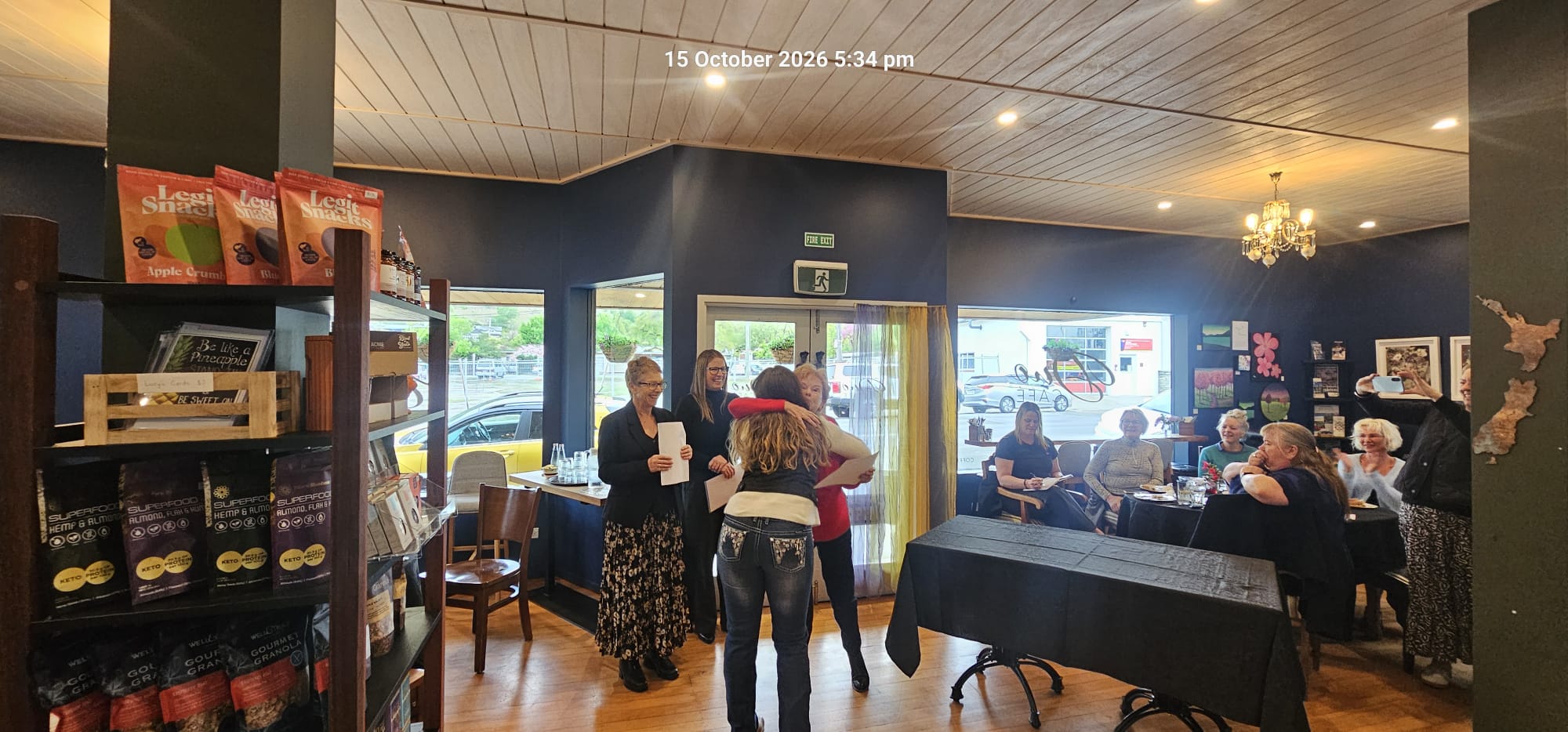
A trip to Clyde to collect a writing prize for Zealanding co-founder Santiago Bonhomme became a larger story about lawyers, words and what can happen when a local business decides to invest in the cultural life of its community.
A NOTE FROM THE EDITORS
Send Zealanding a local story lead, contact, photograph, idea or tip. The best stories often begin with a quiet nudge.