Society
·
Story
New Zealand
What Does New Zealand Think of Its Politics Right Now?
As New Zealand votes, the polls show a fragmented political landscape. But underneath the parties and percentages is a more interesting question: how does the country actually feel about itself?
Cesar Carvajal

The Beehive and Parliament House in Wellington, at the centre of New Zealand's national political life. Photo: ProtoKiwi / Wikimedia Commons, CC BY-SA 4.0. Cropped for layout.
Election campaigns have a strange way of turning a country into a spreadsheet. National goes up, Labour comes down, the Greens move a couple of points, ACT and New Zealand First become part of another coalition calculation, and suddenly everyone is discussing whether Opportunity will cross 5%. Another poll arrives a few days later and the whole conversation starts again. As I have followed the campaign towards the 7 November election, however, I have become less interested in predicting who will govern and more interested in what all of this says about New Zealand itself. What are people actually worried about? How much confidence do they have in politics? Are we becoming more divided, or are we simply living through a difficult period and arguing about how to get out of it? And perhaps the question that interests me most: when people say the country is heading in the wrong direction, does that mean they have stopped believing in New Zealand? Advance voting began on 26 October, so these questions are no longer theoretical. New Zealanders are already answering them with their ballots.
The first thing that seems clear is that the old political map has become less tidy. National and Labour remain the two dominant parties, but recent polling has repeatedly placed them together at only somewhere around the high fifties, leaving a very significant part of the electorate looking elsewhere. The Greens, ACT, New Zealand First and Opportunity are not simply decorations around a two-party contest; under MMP they may help determine what government is possible. I don't read that fragmentation as proof that New Zealanders have suddenly rejected the major parties, but I do think it suggests something has changed in the relationship between voters and the traditional National-Labour choice. More people appear willing to look around, combine ideas that once belonged to different political camps, or vote strategically because they are thinking not only about the party they like but about the government they fear or want to make possible.
The politics of ordinary life
Once you stop looking at parties and ask people what actually worries them, the election becomes much more recognisable. Cost of living is still overwhelmingly the biggest concern in the latest Ipsos research, followed by healthcare and the economy, with unemployment climbing sharply as well. Those findings interest me because political campaigns can become enormously abstract. We talk about ideology, constitutional arrangements, taxes, culture wars, leadership and coalition mathematics, but daily political life is often much simpler. It is the supermarket bill, the mortgage, the rent, whether somebody can see a doctor, whether a young person can find work, whether a family feels that one unexpected expense could push the month off course. Ipsos found cost of living mentioned by almost two-thirds of respondents, while healthcare remained the second-largest concern. Those numbers are useful, but the deeper point is that the anxiety underneath this election is very practical.

Cost of living remains New Zealanders' biggest concern, followed by healthcare, the economy and unemployment. Source: Ipsos New Zealand Issues Monitor, September 2026.
I think that helps explain some of the frustration around politics as well. When people are struggling with things that feel immediate, political language can sound strangely distant. A government can talk about long-term economic settings while somebody is calculating whether they can afford groceries this week. An opposition can promise a different direction while voters remember that it governed before and wonder why everything was not fixed then. Smaller parties can offer clearer or more radical answers because they do not carry quite the same burden of having already been responsible for the entire machine. It becomes easy to understand why political loyalty might weaken when daily life feels expensive and public services feel under pressure. People are not necessarily searching for a new ideology. Sometimes they are simply searching for something that appears capable of working.
That is why I hesitate when I hear New Zealand described as a country moving decisively to the left or decisively to the right. Some of the public-opinion data suggest something much messier. Large numbers of people support asking wealthier New Zealanders to contribute more through taxation, while many of the same electorate also support tougher conditions around welfare or stronger expectations for people becoming citizens. Rent regulation can attract broad support alongside policies traditionally associated with the political right. New Zealanders do not seem to organise their opinions according to the manifestos of political parties. Most people probably never have. We carry our own strange collection of beliefs, shaped by our income, family, culture, age, neighbourhood and personal experience, and then every three years parties ask us to find the box that resembles us most closely.
A country that still belongs to itself
The number that changed the article for me came from somewhere outside the election polling. The Helen Clark Foundation's latest social cohesion research found something that initially looks almost contradictory. Eighty-four percent of New Zealanders still say they feel a sense of belonging to the country and pride in the New Zealand way of life, while only around two in five say they trust the government to do the right thing.
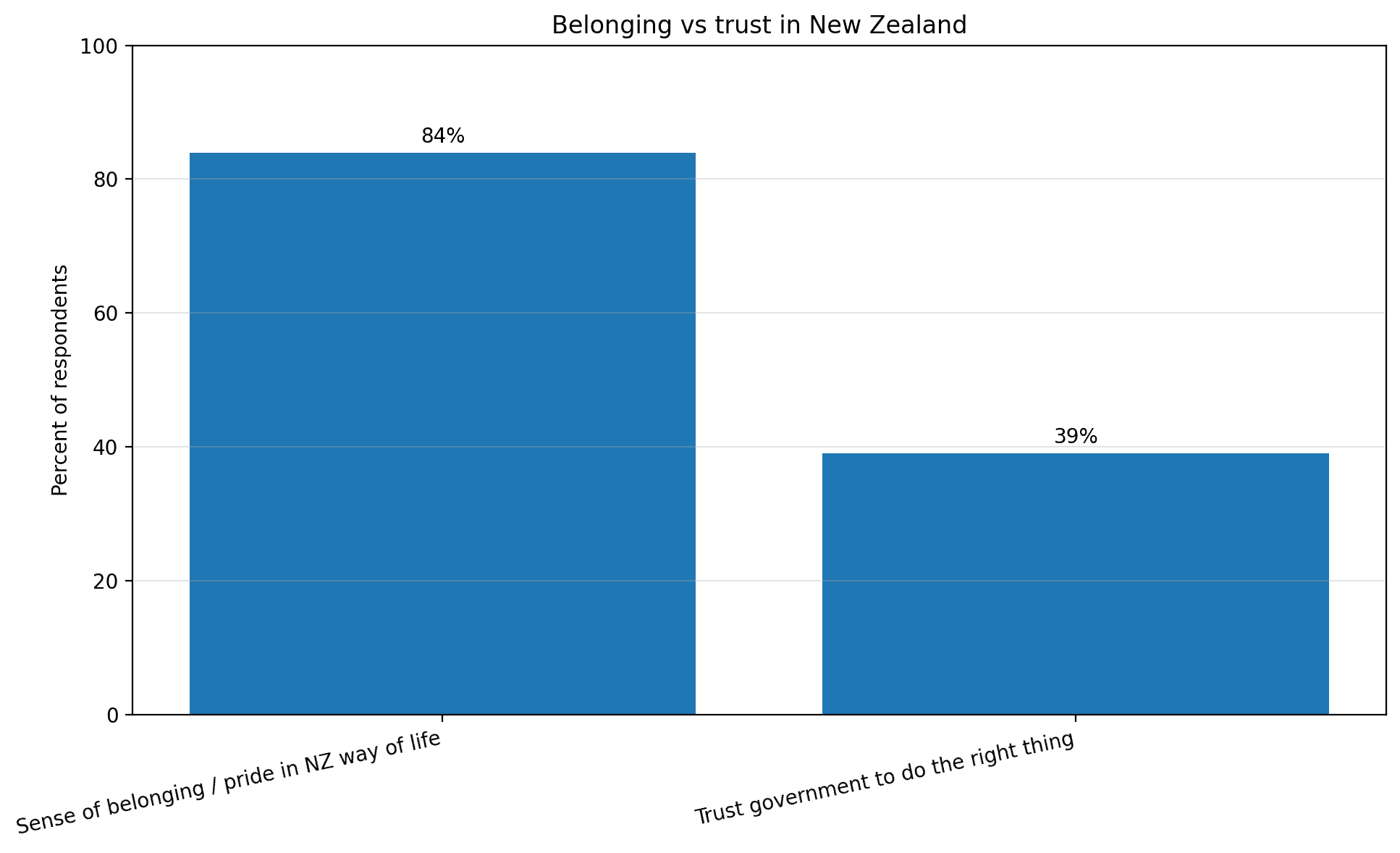
Belonging remains strong even as trust in government is much lower. Source: Helen Clark Foundation, Social Cohesion in New Zealand 2026. The report found 84% report a sense of belonging to New Zealand, while roughly two in five trust government to do the right thing.
I find the space between those two numbers much more interesting than another poll showing National or Labour moving by two points. It suggests that dissatisfaction with politics should not automatically be interpreted as dissatisfaction with New Zealand. People can love a country and still be angry about what is happening inside it. They can feel grateful to live here while worrying about housing, healthcare, employment or the future their children will inherit. They can believe strongly in democracy while having very little enthusiasm for the politicians currently asking for their vote. Perhaps criticism can even become stronger when belonging is strong, because you expect more from a place that feels like home.
That idea also helps me make sense of another part of the social cohesion research. Financial pressure is closely connected with weaker trust, isolation and a declining belief that New Zealand is a land of opportunity. Around a quarter of respondents reported sometimes going without meals because they could not afford food, and the figure was considerably higher among people under thirty. At the same time, the overwhelming majority still felt that they belonged to the country. The result is a political mood that is difficult to describe with a single word. It is not simply anger, because there is still attachment. It is not hopelessness, because people continue to participate and imagine alternatives. But neither is it satisfaction. Perhaps disappointment is closer: the feeling that New Zealand remains a very good idea while everyday reality is not always living up to it.
I recognise something in that feeling as a migrant too. I did not grow up here, so I am still capable of seeing many things about New Zealand that can become invisible when you have known them all your life: institutional stability, extraordinary public spaces, a functioning democracy, relative safety and the possibility of participating in society without needing to belong to some particular family, class or network. Those things are valuable. But loving what a country gets right should never require pretending that everything works well. In fact, perhaps belonging eventually means becoming willing to participate in the argument about how the place could work better.
Then I went into the comments
I wanted to see what happened when I left the polling reports and entered the places where people were arguing without a questionnaire in front of them. For this article I spent time reading recent political discussions on r/newzealand, r/nzpolitics and Kiwiblog. I deliberately chose spaces with very different political cultures, and I did not try to turn the comments into another set of percentages. Reddit is not New Zealand, Kiwiblog is not New Zealand, Facebook is not New Zealand, and none of them should be treated as representative public-opinion research. What they can show us is something surveys struggle to capture: the language people use when politics becomes personal.
The experience was almost like visiting different countries. In the Reddit discussions I read, there was considerable hostility towards the current government, anxiety about another National-led administration and an extraordinary amount of discussion about strategic voting. Opportunity appeared repeatedly, sometimes less as a political philosophy than as a mathematical question: could voting for this party change which bloc was capable of forming a government? In Kiwiblog, many of the same polls generated almost the opposite anxieties. There, commenters worried about Labour, the Greens, welfare spending, taxation and what a left-led coalition might mean. The same country, the same election, sometimes even the same poll, but two very different versions of reality.
I don't think that means New Zealand is uniquely polarised. The internet is exceptionally good at gathering people with similar frustrations and then convincing them that everybody reasonable must see the world the same way. What interested me more was how the tone changed whenever discussion moved from parties to ordinary economic pressure. Talk about groceries, insurance, rent, mortgages, wages or healthcare became less ideological and more recognisable. People who might disagree completely about which party should govern could still understand the feeling of money disappearing faster than expected. The party argument divides people; the supermarket receipt can bring them back into the same conversation.
Perhaps that is something political coverage sometimes misses. Underneath a loud argument about Labour, National, the Greens, ACT, New Zealand First or Opportunity, people are often describing similar fears in different political languages. They want stability. They want a reasonable chance of improving their lives. They want public services to work. They want their children to have opportunities. They want to feel that the rules are reasonably fair and that somebody in Wellington understands how ordinary life actually feels. They disagree, sometimes profoundly, about how those things should be achieved, but the aspirations themselves may be less different than the internet makes them look.
What does New Zealand think?
After reading the polls, the social cohesion research and far too many political comments, I don't think New Zealand has one political mood. The country seems dissatisfied but not hopeless, fragmented but not necessarily broken, sceptical about politics while still strongly attached to the place itself. People are under economic pressure and concerned about public services, while traditional political loyalties appear weaker and smaller parties are finding more room. At the same time, New Zealand has not suddenly become a nation of ideological extremists. Most people seem to hold mixtures of views that would make any political strategist uncomfortable.
The contradiction I keep coming back to is the same one: a country where more than eight in ten people still feel that they belong, while trust in government sits much lower. Somewhere inside that gap may be the political story of New Zealand in 2026. People have not necessarily stopped believing in the country. They are questioning whether the political choices available to them are delivering the country they believe New Zealand can be.
And maybe that is healthier than it first appears. Democracy is not supposed to produce permanent satisfaction. It is a system for allowing millions of people who disagree about almost everything to keep negotiating a shared life without having to agree on a single version of the future. The arguments can be exhausting, especially during an election campaign, and social media can make them look uglier than they really are. But underneath the shouting there is still a remarkable level of agreement on one fundamental point: this place matters.
New Zealanders are already voting. On 7 November we will know much more about the government they want, although under MMP we may still have negotiations ahead before we know exactly what that government looks like. The result will tell us who gets to govern for the next three years, but it will not resolve the larger conversation about cost of living, public services, trust, fairness and opportunity.
Perhaps elections are not supposed to resolve those questions anyway. Perhaps they are simply one moment when a country stops, looks at itself and decides which direction it wants to try next. And from everything I have seen in the numbers and the conversations around this election, New Zealand still believes strongly in itself.
It just isn't entirely convinced by its politics.
About the research
This article draws on recent election polling, the Ipsos New Zealand Issues Monitor, the Helen Clark Foundation's 2026 Social Cohesion research, OECD research on institutional trust, 1News Vote Compass findings and public political discussions on r/newzealand, r/nzpolitics and Kiwiblog.
The forum review was qualitative rather than representative: comments were used to understand recurring arguments and language, not to estimate what percentage of New Zealanders hold particular views. Political polls and voluntary tools such as Vote Compass also use different methodologies and should not be treated as interchangeable.
Public-opinion and forum research cut-off: 25 October 2026. Election timetable checked 27 October 2026.
Sources & Further Reading
I would keep the body completely clean and put this block at the bottom.
Elections NZ - 2026 General Election key dates
Use for advance voting and the 7 November election date. Advance voting began 26 October.
Elections NZ - Key dates for the 2026 General Election
Ipsos New Zealand - Issues Monitor, September 2026
Use for cost of living, healthcare, economy and unemployment.
Ipsos - 34th New Zealand Issues Monitor
Helen Clark Foundation - Social Cohesion in New Zealand 2026
Use for belonging, trust, food insecurity, financial stress and the broader cohesion discussion.
Helen Clark Foundation - Social Cohesion in New Zealand 2026
1News / Verian - October political polling
The 15-19 October poll had National at 32%, Labour 27%, Greens 16%, ACT 11%, NZ First 8% and Opportunity 7%; the poll explicitly describes itself as a snapshot, not a prediction.
1News - October 20 Verian poll
1News Vote Compass - political attitudes
Useful background for the discussion of mixed ideological attitudes. Vote Compass found 62% support for wealthier people paying more tax, while other analyses found substantial support for rent limits and citizenship requirements.
1News - Wealth and tax Vote Compass findings
1News - Issues dividing and uniting voters
1News Vote Compass - welfare and leadership
Useful background for the discussion of views crossing traditional left-right boundaries and relatively weak leader favourability. 1News
OECD - Trust in Public Institutions 2026
Use for the distinction between trust in political institutions, political voice and broader institutional confidence. OECD
Online discussion sample
Kiwiblog was used alongside Reddit communities as a qualitative counterpoint, not as representative polling. The October 20 Kiwiblog discussion demonstrates the markedly different interpretation of the same Verian poll.
Keep the conversation going
This story doesn’t end here.
Read something that stayed with you? Join the discussion, meet the writer behind the story, or help make the next one possible.
Join the discussion on Facebook

Cesar Carvajal
Cesar Carvajal is a writer and editor in New Zealand. A former lawyer, he writes about migration, society, culture, politics and the ways people build meaning and belonging.
Buy the team a coffee
Tag Zealanding on Instagram
Keep Zealanding

Society
Why New Zealand Celebrates Labour Day in October
Why does New Zealand celebrate Labour Day in October rather than on 1 May? The answer begins with an English carpenter in Petone - and leads to a question that remains surprisingly current.

Society
S(h)easonal Workers
Through seasonal workers’ testimonies, Alexandra Zapata examines gender, migration, vulnerability and informal power within New Zealand’s horticultural workforce.

Society
What Does a Business Owe the Place Around It?
Businesses create jobs, ideas and wealth, but they also leave a footprint. What responsibility do we carry for the people and places around us?
A NOTE FROM THE EDITORS
Send Zealanding a local story lead, contact, photograph, idea or tip. The best stories often begin with a quiet nudge.