Food
·
Story
Central Otago, New Zealand
The Surveyor in the Glass
I went to Domaine Thomson for Pinot Noir and a cheese board. I left thinking about maps, mountains, terroir and the strange ways a life can continue influencing people generations later.
Cesar Carvajal

Surveyor Thomson Pinot Noir at Domaine Thomson in Central Otago. Photo: Cesar Carvajal / Zealanding
Our plan at Domaine Thomson was fairly simple: enjoy a wine tasting, have a cheese board and spend some time in one of those Central Otago landscapes where doing very little can already feel like a perfectly productive afternoon. The cellar door sits above the Cromwell Basin, with rows of vines moving across the land towards Lake Dunstan and the dry mountains beyond, and from inside the tasting room the whole scene seems to enter through the windows. We were happy enough with that. There was Pinot Noir in front of us, cheese on the table and sunshine outside, which is not a combination I normally feel the need to complicate with too many philosophical questions. But somewhere during the tasting I started paying attention to the room itself, and that was when the visit changed.
There was a portrait hanging above the fireplace. There were paintings and historical objects around the room, and then I saw an old map. It was a reconnaissance survey of part of Otago Province, executed in 1857 by J. T. Thomson, Chief Surveyor. I had already noticed that the bottle in front of us was called Surveyor Thomson, but until that moment I had treated the name as part of the branding. Once I started asking questions, the bottle, the portrait, the map and the landscape outside began connecting with one another, and I realised that the winery we had entered for a tasting was also carrying a family story that went back to some of the earliest European mapping of inland Otago.

An 1857 reconnaissance survey of part of Otago Province by J. T. Thomson, displayed at Domaine Thomson. Photo: Cesar Carvajal / Zealanding
The man behind the label
John Turnbull Thomson was the great-great-grandfather of Domaine Thomson co-founder David Hall-Jones. He had already spent years working as a surveyor and engineer in Penang and Singapore before coming to New Zealand in the 1850s, where he was appointed Chief Surveyor of Otago. During 1857 and early 1858, he undertook an extraordinary reconnaissance survey of the province, travelling vast distances on horseback and recording a landscape that European authorities still understood only imperfectly. His work contributed to the first published map of Otago’s interior in 1860, and he later became New Zealand’s first Surveyor-General, helping standardise surveying across the colony.
Thomson also left his name, or names chosen by him, across the southern landscape. Historical records connect him with the naming of places including Lindis Pass, Mount Aspiring, Mount Pisa, Mount Earnslaw and Mount St Bathans, often drawing on names connected with his own life and the country he had come from. Domaine Thomson says the Pisa and St Bathans ranges overlooking its Central Otago vineyard are part of this legacy, and even the winery’s crest includes a theodolite, the surveying instrument associated with Thomson’s expeditions. Some of his maps and paintings are displayed at the cellar door, which means the family history is not hidden somewhere in an archive; it is physically present while you drink the wine.

John Turnbull Thomson, whose surveying history remains visible throughout Domaine Thomson’s cellar door. Photo: Cesar Carvajal / Zealanding
I found that fascinating because suddenly the portrait on the wall was no longer decorative and the name on the bottle was no longer something created to make the wine sound distinguished. There was an actual person behind it, and that person had spent part of his life moving through and measuring the enormous landscape we could see outside the window. More than 160 years later, one of his descendants had created a vineyard within that same broad geography and put his name on the Pinot Noir. There is something about that kind of continuity that immediately makes me curious, because it makes you wonder how much of what we do survives us and in what strange forms it might eventually reappear.
A map is not the beginning of a place
Old maps are beautiful objects. I have always liked them because they seem to contain two worlds at once: the physical landscape and the mind of the person attempting to understand it. Looking at Thomson’s survey, I could imagine the enormous effort required to travel through nineteenth-century Otago with horses, notebooks and surveying equipment, taking measurements and trying to transform rivers, mountain ranges and distances into lines on a sheet of paper. Even now, when we can open a phone and know exactly where we are within seconds, there is something impressive about the scale of that work.
At the same time, the longer I thought about it, the more important it felt not to confuse the beginning of a European map with the beginning of the landscape’s history. Thomson was surveying a country that was already known, travelled, named and understood in other ways. Ngāi Tahu tīpuna had long moved through the interior of Te Waipounamu following seasonal routes associated with mahinga kai, trade and travel. Ōmakō, the Ngāi Tahu name associated with the Lindis Pass area, formed part of an important ara tawhito connecting the Waitaki with the lakes of Central Otago, and the wider region carried relationships with food gathering, settlements, waterways and resources long before colonial survey lines appeared.
Surveying was therefore never only a technical activity. Historical accounts of Thomson acknowledge his importance as an engineer and surveyor, but his work also belonged to a colonial system through which land was being mapped, divided and made available for European settlement. I actually think acknowledging that complexity makes the story more interesting rather than less. History becomes too thin when every person has to be either a hero or a villain. Thomson was a highly capable surveyor and engineer whose work had enormous consequences for southern New Zealand, while at the same time operating within a system that was reshaping who could map, name, own and settle the land. Both things belong in the story, and both are present in some way when we look at that old map today.
From survey lines to vine rows
More than a century later, another generation of the family began reading the land in a completely different way. David Hall-Jones and his wife and co-founder, PM Hall-Jones, founded Domaine Thomson in 2000. Their connection with Pinot Noir had been developing through Burgundy, and during a family stay in Gevrey-Chambertin that year they signed the contract to buy the land at Lowburn in Central Otago. A year later they bought a house in Burgundy, creating the beginnings of what would become an unusual wine project linking New Zealand and France through a shared fascination with Pinot Noir.
Their Central Otago vineyard covers around 14 hectares on elevated north-east-facing terraces overlooking the Cromwell Basin and Lake Dunstan. The vineyard is divided into several blocks, planted on soils that include loess and glacial moraine, and Pinot Noir is the central variety. The first Surveyor Thomson Pinot Noir was made in 2003 by Dean Shaw, who continues to make Domaine Thomson’s New Zealand wines.

Domaine Thomson’s Lowburn vineyard overlooking Lake Dunstan and the Central Otago landscape. Photo: Cesar Carvajal / Zealanding
When we walked outside and looked back across the vineyard, another connection started forming in my mind. The vines run through the landscape in long, deliberate lines, held by posts and wires, with Lake Dunstan sitting behind them and mountains filling the horizon. It is obviously nothing like a nineteenth-century survey, but visually there is still something about order, observation and the human desire to understand land. Thomson approached the country through bearings, distances, triangulation, rivers and mountain ranges, while a vineyard approaches it through sunlight, altitude, frost, slope, soil, drainage, roots, rain and seasons. One tries to understand where the land is; the other becomes obsessed with what the land can express.
Somewhere between those two ways of looking, I started thinking about terroir.
Trying to taste a place
Wine people talk about terroir so often that the word can sometimes become almost mystical, as though the soil whispers directly into a grape and then waits for somebody sophisticated enough to identify it. But stripped of all the romance, the idea is actually quite simple and beautiful: a wine is partly a consequence of where it came from. Soil, climate, altitude, slope, weather, water, farming and human decisions interact over time, and what eventually arrives in the glass carries something of that particular place.
Domaine Thomson has built a significant part of its philosophy around that relationship. After roughly a decade of conventional viticulture, David and PM began exploring how the vineyard might express its site more clearly. The Lowburn vineyard began converting to organic farming in 2011, biodynamic practices were introduced in 2013, and the property has been fully BioGro certified organic since 2014. The winery describes the shift as a way of allowing the vines and terroir to express themselves more fully, with much of the vineyard work still done by hand.
That history gave me an unexpected way of thinking about the family connection. A surveyor spends his life paying attention to place, although through the instruments and assumptions of his profession and his time. Generations later, the family created a business that also depends on paying extremely close attention to place, only now the questions are different. Instead of asking where a mountain begins or how one point relates to another, they are asking how vines behave on one slope, what happens in a particular soil, what a season does to the fruit and how much intervention is necessary before the character of the vineyard gets lost. The relationship is not literal, of course. I don't think John Turnbull Thomson secretly began a 160-year plan to produce Central Otago Pinot Noir, but there is something poetic in the continuity: a family once measured the landscape, and another generation learned to taste it.

Vines, Lake Dunstan and the Central Otago mountains framed from the grounds of Domaine Thomson. Photo: Cesar Carvajal / Zealanding
The landscape enters the room
One of my favourite photographs from the visit is not actually of the wine. It is that view through the old wooden frame in the garden, where vines, Lake Dunstan and the mountains appear almost as if somebody had turned the landscape into a painting before your eyes. Another photograph I took inside the tasting room does something similar: paintings hang on either side of a window, while through the glass the real vineyard and mountains occupy the centre.
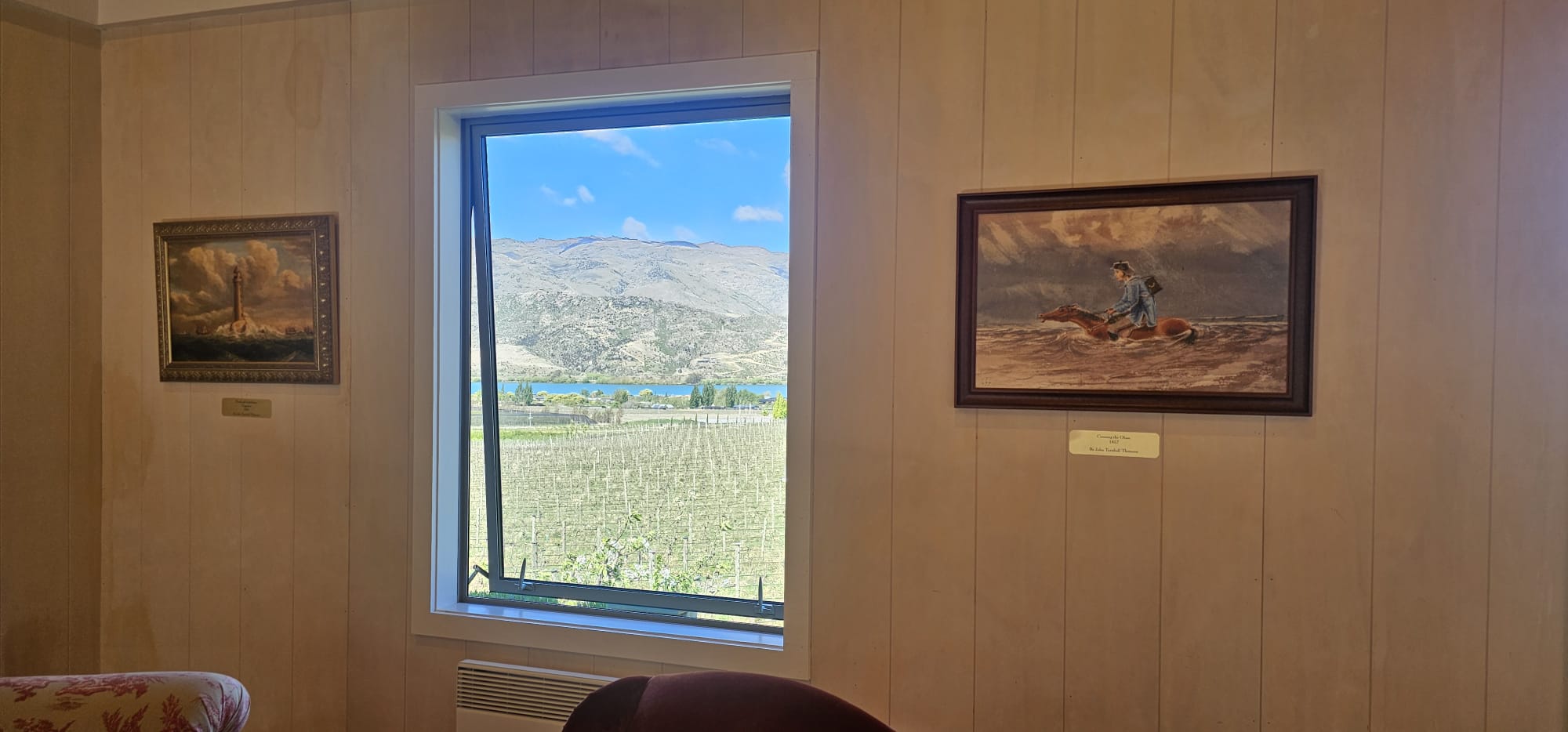
Inside the cellar door, paintings and family history sit beside a window looking directly onto the vineyard. Photo: Cesar Carvajal / Zealanding
That visual relationship stayed with me because Domaine Thomson sometimes feels less like a conventional cellar door and more like a conversation between landscape, family archive and wine. There are the maps, the portrait, the old stories, the modern vineyard, the bottle on the table and the view outside, and none of them feel completely separate after you know how they fit together. Even the Surveyor Thomson bottle changes once you know the story: at the beginning of the tasting the name is simply a label, but by the end you understand that it refers to a man whose descendants created a business that carries his history while simultaneously producing something he could never have imagined.
That is the part that interested me most.
What survives us
David Hall-Jones died in August 2024 after living with cancer for several years. He had built Domaine Thomson with PM over more than two decades while also having a distinguished legal career, including work in Hong Kong and service as a Deputy High Court Judge. The family continues the project today, with PM and the next generation carrying forward the original vision across New Zealand and France. Thomson Wines
Learning that added another layer to a story already preoccupied with inheritance. The vineyard had been created partly around David’s connection to his great-great-grandfather, and now David himself has become part of the history being carried forward by the people who come after him. In one family, legacy has moved through several forms: surveying, maps, stories, law, vineyards, Pinot Noir and now the responsibility of another generation deciding what to preserve and what to make their own.
We often talk about legacy as if it needs to be something monumental. Perhaps we imagine buildings with somebody’s name on them, fortunes passed from one generation to another, foundations, statues or large achievements that make it into history books. But sitting there, I started thinking that legacy may be much less predictable than that. Sometimes one person simply lives with enough curiosity or intensity that something remains available for another generation to pick up. It might be a map, a story, a piece of land, a profession, a particular relationship with a place or even a way of paying attention, and the person who leaves it behind has very little control over what happens next.
John Turnbull Thomson could not possibly have imagined somebody holding a bottle of Pinot Noir with his name on it in Central Otago in 2026. David Hall-Jones took that family history and turned it into something completely new rather than simply preserving it behind glass, and now his own family must decide how the story continues. I find that moving because it makes legacy feel less like trying to control the future and more like giving the future something useful to work with.
Back to the wine
Eventually, of course, we returned to the reason we had arrived. There was still Pinot Noir in our glasses and there was still cheese on the wooden board, although by then we had done enough damage to it that describing it as a full cheese board would have been historically inaccurate. Outside, the Central Otago light was moving across the vineyard and the mountains, and the whole landscape had that dry, enormous quality that makes this part of New Zealand feel so distinct.

Pinot Noir and cheese brought us to Domaine Thomson. The story surrounding them kept me looking a little longer. Photo: Cesar Carvajal / Zealanding
The bottle beside us still said Surveyor Thomson, but by then I was reading the words differently. We had arrived for a wine tasting, but I found myself drinking something surrounded by context. The wine came from vines growing in a landscape connected to the family story; the landscape sat beneath mountains carrying layers of Māori and colonial history; the map on the wall recorded one nineteenth-century attempt to understand that country; and the family that later created the vineyard had turned those inherited stories into something alive rather than leaving them in the past.
I don't think wine needs a complicated story to be enjoyable. Sometimes a glass of Pinot Noir can simply be a glass of Pinot Noir, and there is absolutely nothing wrong with that. But places become more interesting when you stay long enough to notice what sits behind them, and on this occasion the wine opened a door into something much larger than tasting notes.
We went to Domaine Thomson for Pinot Noir and cheese. I left thinking about how people understand land, how names travel through history, how families inherit stories and how one generation can create something that another generation transforms completely. Looking again at the old map, the portrait and the vineyard outside, I realised they were not really three separate things. They were different moments in the relationship between a family and a place, each one adding another layer without erasing what came before.
And perhaps that is the part I will remember next time I see Surveyor Thomson written on a bottle: somewhere inside the glass there is Pinot Noir, of course, but around it there is also a map, a landscape and more than 160 years of people trying, in very different ways, to understand where they are.
Sources & further reading
Te Ara - John Turnbull Thomson
Biography and historical context for Thomson's work in Otago, place naming and his later role as Surveyor-General. John Turnbull Thomson - Te Ara
Te Rūnanga o Ngāi Tahu - Whenua: Ōmakō
Context on Ōmakō/Lindis Pass, ara tawhito and the Ngāi Tahu mahinga kai network in the interior. Whenua - Te Rūnanga o Ngāi Tahu
Heritage New Zealand Pouhere Taonga - John Turnbull Thomson
Historical context on Thomson's surveying career and the relationship between surveying and European settlement. John Turnbull Thomson - Heritage New Zealand
Domaine Thomson - Our Story
Family history, David and PM Hall-Jones, Burgundy, John Turnbull Thomson and the origins of Domaine Thomson. Domaine Thomson - Our Story
Domaine Thomson - Our Vineyards
Lowburn vineyard, terroir, soils, Pinot Noir, organic certification and biodynamic practices. Domaine Thomson - Our Vineyards
Domaine Thomson - Our People
Background on David Hall-Jones, PM Hall-Jones and the people continuing the Domaine Thomson project. Domaine Thomson - Our People
Keep the conversation going
This story doesn’t end here.
Read something that stayed with you? Join the discussion, meet the writer behind the story, or help make the next one possible.
Join the discussion on Facebook

Cesar Carvajal
Cesar Carvajal is a writer and editor in New Zealand. His work explores migration, culture, place, identity and the ways people build meaning and belonging.
Buy the team a coffee
Tag Zealanding on Instagram
Keep Zealanding

Food
From Aguapanela to the Aid Station
A Colombian staple travelled from family kitchens and cycling jerseys to New Zealand endurance sport. This is the journey of panela.
Food
The Geography of Gin
From the foothills of the Andes, Gin Provincia distils Chile not as a map, but as aroma, memory and landscape.
A NOTE FROM THE EDITORS
Send Zealanding a local story lead, contact, photograph, idea or tip. The best stories often begin with a quiet nudge.